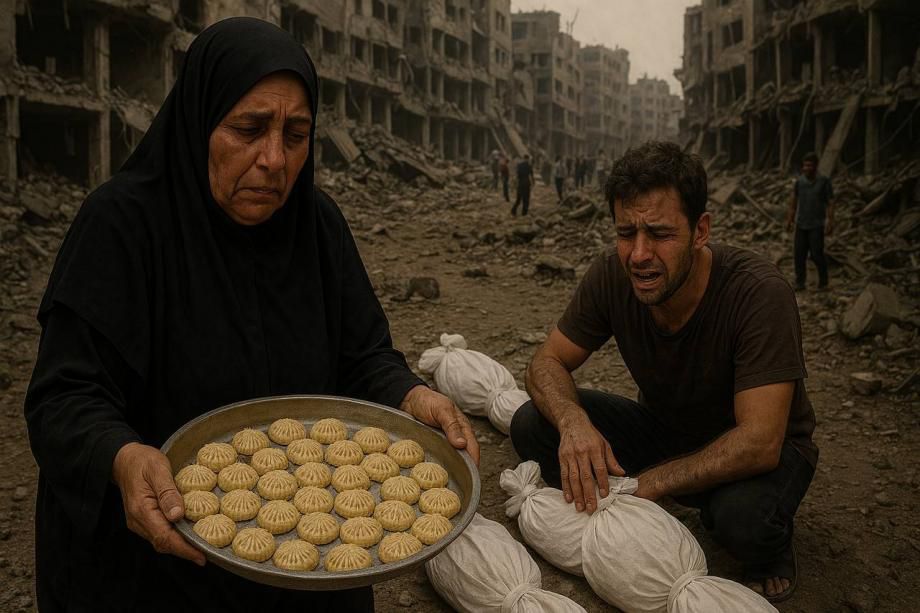
The Story of the Shuja'iyya Massacre
When mothers baked Eid maamoul (holiday cookies), the shelling distributed them among the shrouds.
“Can you hear us? If you can hear us, knock on the stones—stay alive! We’re trying to lift the rubble… we can’t breathe!”
These were the voices of survivors above the ruins and those trapped beneath them. Those who still had a few centimeters of space between two collapsed ceilings never stopped calling out for help. That narrow gap gave them a small breath of air—mixed with dust and sand that filled their mouths—while tons of debris pressed down on their bodies. They clung to the thread of life until their final moments.
Before a mountain of rubble that had once been a residential block, residents and rescue teams stood powerless. With no heavy machinery or proper equipment, they dug with their bare hands and primitive tools, desperate to reach those trapped below. They clawed toward the edges of the ruins for hours. Their helplessness was most visible when they reached a man whose foot was trapped beneath a massive concrete beam while his body lay outside the rubble. Lacking anesthesia or medical supplies, paramedics had no choice but to amputate his leg on site. His screams pierced the air before he was taken to the hospital, where he later died from severe bleeding.
The cries for help echoed beneath the destroyed homes—bombed by Israeli forces targeting a residential block in the Shuja’iyya neighborhood, east of Gaza City, on Wednesday morning. Buried beneath the rubble were the dreams of children who had sought joy and never found it, and of women who had returned from displacement to prepare ka‘k and ma’moul (Eid pastries) after a deceptively calm day. The atmosphere of Eid was drowned by the sound of cries and the blood of dozens of martyrs.
In the courtyard of Al-Ahli Baptist Hospital, near where the bodies were being wrapped for burial, Shahd Abu Amsha sat against a wall, her face carved with pain and grief.
“We evacuated to my aunt’s house after the evacuation orders,” she told Falasteen newspaper. “Then my cousin called and said things were calm in Shuja’iyya, so he came to take the women of the family back.”
“My sister Rasmiya didn’t want to go, but she went to feed her husband, who hadn’t eaten bread for three days and was surviving on beans. She wanted to cook something for him, so she took her daughter Lama (7 years old) and left her other two children, Karam (3) and Lana (4), with me.”
Shahd recalls her sister’s last words at the door:
“I’m leaving Karam and Lana with you—they carry my scent. Take care of them if I’m martyred.”
She wipes away tears, trying to stay composed as she waits for the bodies of her two sisters to be pulled from the rubble. “There were more than fifty people in that house—our family, the Abu Amsha family, and our in-laws, the Abu Halima family.”
Seconds before the strike, her sister Diana called:
“I just arrived at Rasmiya’s house; I’ll have breakfast here.”
Moments later, another call came from her cousin:
“The five-story building collapsed on everyone inside.”
And then came the catastrophe.
A week earlier, Diana had been displaced to her husband’s family, then came to visit her mother. “We sat together, happy for the first time since the war began,” Shahd said. “She slept over, and in the morning her husband came and took her back to their home in Shuja’iyya.”
“She joked with me, saying: ‘I’m suffocating—I want to go home; there’s no place like our house.’ Before Eid, she had bought clothes for the children but never got to enjoy them. She went for breakfast—but it became a meal soaked in blood. She was martyred with her husband.”
The Gathering for Ka‘k and Ma’moul
After the evacuation orders, the family had fled. But when some neighbors returned, the women decided to go back for one day to bake Eid cookies. Among them was Nour Mar‘i Abu Amsha, who said:
“My mother woke me up in the morning. My uncle, who had stayed at the house, said, ‘The night was quiet—come back.’”
Her tears fall as she recalls the hours before the massacre.
“Before we fled, we each contributed ten shekels to make ka‘k, but we had to delay it because of the leaflets dropped from the planes. My mother thought today would be a good day.”
Her brothers, Abdel Rahman (9) and Mohammed (13), joined their mother, craving a taste of normalcy amid displacement. The mother tried to create a bit of Eid spirit.
“They buried our joy and tore apart our family,” Nour said in a broken voice.
During the bombing, her mother hugged Abdel Rahman and tried to call for help. She managed to free his head and Mohammed’s from under the rubble—they were both crying. Mohammed survived and was taken to surgery, but their mother, father, and Abdel Rahman were all killed.
Their neighbor, Yasmeen Abu al-Kas, sat beside Nour and Shahd, trying to comfort them. Having already lost her son earlier in the war, she said:
“When the houses collapsed, we rushed to help those thrown into the streets by the blast. But we were helpless before our loved ones still trapped inside, calling out until their voices faded.”
“We kept hearing them under the rubble from morning till afternoon. We called their phones—they rang. We knocked on the walls, and they knocked back. We knew they were alive, but time was running out.”
Endless Funerals
Families were scattered between hospitals and cemeteries, burying martyrs as they were pulled out one by one. “We just want to recover them—to honor and bury them,” said Abu al-Kas.
She recalls: “We pulled out a child with a spinal injury, and a young man whose leg had to be amputated below a concrete pillar—his body was outside the rubble, but he later died from bleeding.”
She still doesn’t know the fate of her husband’s brother, who remains trapped under the ruins, leaving behind an orphaned child after his wife, Israa Salman, was killed at the start of the war.
With a burning heart, she added:
“I lost my son Mohammed—they targeted him while he was trying to rescue his father. He was martyred. His father and brother Mahmoud both lost their legs. Now I’m the only one providing for the family. This is the story of every home in Gaza.”
Then she cried out to the world’s conscience:
“What was the fault of baby Ibrahim Ali Abu Amsha—only a month old—to be killed? Or his two-year-old sister? Or their mother, Nour, still buried under the rubble?”
The Shuja’iyya Massacre will remain one of thousands that the Gaza Strip will never forget—a wound etched into the memory of generations, a slap to the world’s silent conscience before the cries of children beneath the ruins
ناجية
The Story of the Shuja'iyya Massacre
Shuja'iyya Massacre
حي الشجاعية
Age: 24
December 01, 2025