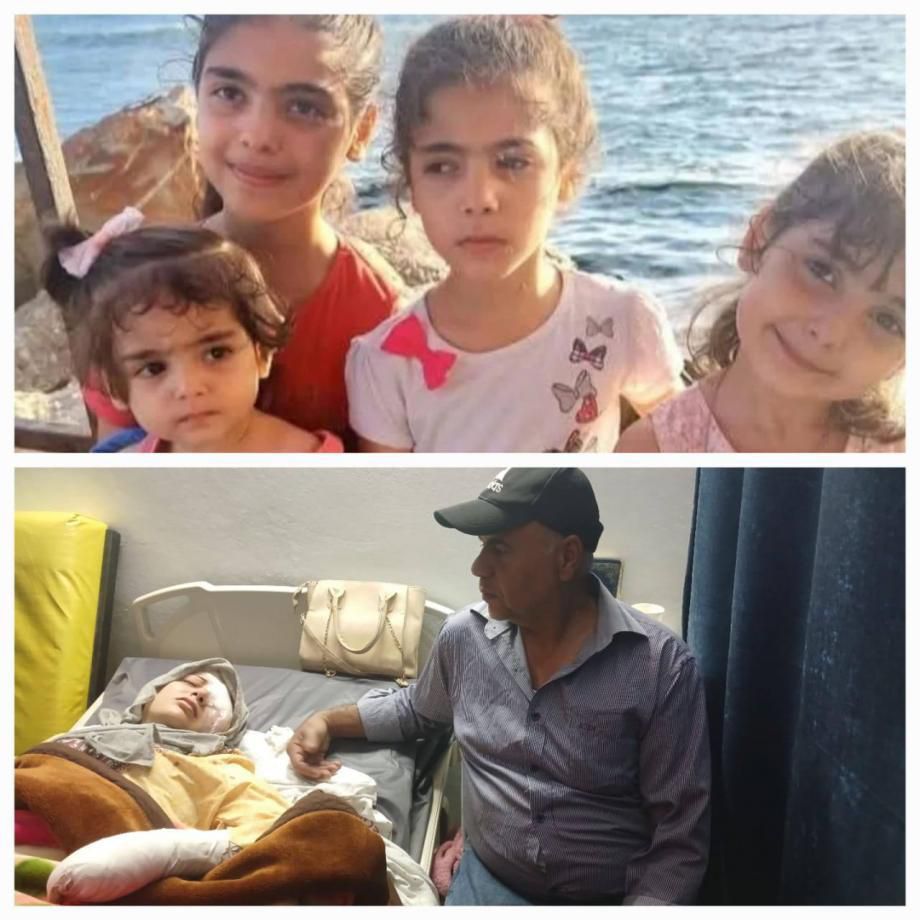
The Story of Alaa al-Arabeed
“Mira Never Blew Out Her Birthday Candle”
Alaa al-Arabeed – the sole survivor who missed the final farewell to her daughters and husband
"Your daughter is injured, not martyred."
The doctor’s words were not enough to bring relief to Hajj Mahmoud al-Arabeed’s heart—nor to help him breathe as he searched among the morgues of martyrs. In that unbearable moment, he stumbled upon the bodies of his four granddaughters and their father. His heart broke, his tears fell uncontrollably, and he sat among their lifeless bodies until morning—keeping to himself the crushing weight of the tragedy.
While doctors operated on his daughter Alaa, the only survivor of the massacre that took place at dawn on Tuesday after the Israeli bombing of Al-Andalusia Tower in western Gaza City, her father carried the bodies of his son and granddaughters—dressed not in their long-awaited Eid clothes, but in white shrouds. They had waited eagerly for a joy denied to the children of Gaza, hoping to feel the happiness stolen by a war that took every smile and extinguished every dream of a life without death.
At the cemetery, tears never stopped streaming from the eyes of the grieving grandfather, known as Abu Muhammad. Standing before the bodies of his granddaughters—Maha (12), Mira (10), Juana (8), and Lian (4)—and their father, Mahmoud Basem al-Arabeed, he bid them a final farewell in the absence of their mother. He placed two sisters in each grave, and buried their father beside Juana and Lian.
In that moment, the sweetness of memory overpowered the bitterness of grief. Before the burial, scenes from their lives flashed before his eyes—how they used to open the door for him with joy, how Lian and Juana would race to hug him first, how he would play with Maha and Mira, and how he had hidden a birthday gift for little Mira, who never got to blow out her candle.
Meanwhile, in the emergency ward of Al-Shifa Hospital in Gaza City, Alaa lay unconscious—unaware of the details her family knew too well. She was battling her injuries: head, eye, and hand trauma that led to the amputation of two fingers, a stomach wound, and shrapnel in her foot. She did not yet know that the wound awaiting her when she awoke would pierce her heart far deeper than any physical pain.
At 2:00 a.m., as explosions thundered across Gaza and news spread of a strike on the fifth floor of Al-Andalusia Tower, her father rushed to his phone, calling her again and again. When she didn’t answer, dread filled his heart. “I went straight to the hospital,” he recalled. “I heard they had fallen from the fifth floor onto the ground next door. I searched for her among the martyrs but couldn’t find her, so I went to register her as one. The doctor stopped me and said: ‘She’s injured, not martyred.’ Even with that, I was overwhelmed with pain—for my granddaughters and their father who were gone.”
He spoke to Falasteen newspaper as he stood several meters away from his daughter’s bed—so she wouldn’t overhear.
At sunrise, he returned to the site of the massacre. There he found his daughter’s mattress on the ground—perhaps the reason she survived, as she had fallen on it. Nearby, the bloodstains of his granddaughters marked the earth that had embraced them. “It’s God’s will,” he said quietly. “He destined her to live—and that mattress was her means of survival.”
Speaking of the farewell he couldn’t share with his daughter, his voice trembled with pain and restraint:
“It’s unbearable for a mother to miss such a moment. But my daughter’s condition doesn’t allow her to move. I was afraid to tell her the truth—it might break her. Now I’m waiting for her to improve before I tell her what happened. When she woke up from anesthesia, I told her her daughters are at our house. That’s all I can think about now—how will I tell her? What words can I possibly use?”
These questions haunt his thoughts as he keeps vigil by her bedside. Glancing toward her frail body, he continued:
“When she wakes up, she asks about her daughters, and I tell her they’re home. She drifts in and out of sleep. Sadly, there’s not enough treatment available—she lies on a bed in a crowded hall, separated from others by thin curtains. But this is all we have… these are our means.”
Martyrdom and Birthday
The family had been preparing to celebrate little Mira’s birthday on March 18—a date now etched in memory as both her birthday and the day of her death. The joy that was meant to fill her mother’s heart has turned into eternal sorrow.
When Alaa’s father recalled his daughter’s excitement for that day, tears overtook him.
“She invited me to Mira’s birthday,” he said. “I told her I’d come. I never imagined I would instead be the one to wrap her in a shroud and carry her to her grave with my own hands. Those were moments beyond pain—unimaginable, indescribable… like living a nightmare I can’t wake from.”
The small family had been bound by love, living peacefully together in a warm, affectionate home. They spent their days in the spirit of Ramadan, eagerly awaiting Eid, hoping the war would end and the rivers of blood would stop flowing.
“My daughter was deeply devoted to her girls,” Abu Muhammad said softly. “She dedicated her life to teaching and raising them with care. Their father was a kind, honorable man—a loving husband and father. Their life together was beautiful.”
His voice faltered, heavy with sorrow.
Just days before the massacre, Abu Muhammad had visited their home when his daughter invited him for an iftar meal. He recalled with bitter irony the words he said then:
“I told her that if conditions improved and the crossings opened, I’d come for iftar. But for now, I knew she could barely meet her family’s needs.”
Now, instead of joining them for a family meal, he visits their graves—carrying in his heart the memory of Alaa, the mother who survived, and the silence of her four daughters who never got to blow out their birthday candles
ناجية
The Story of Alaa al-Arabeed
Alaa al-Arabeed
قطاع غزة
Age: 35
December 01, 2025