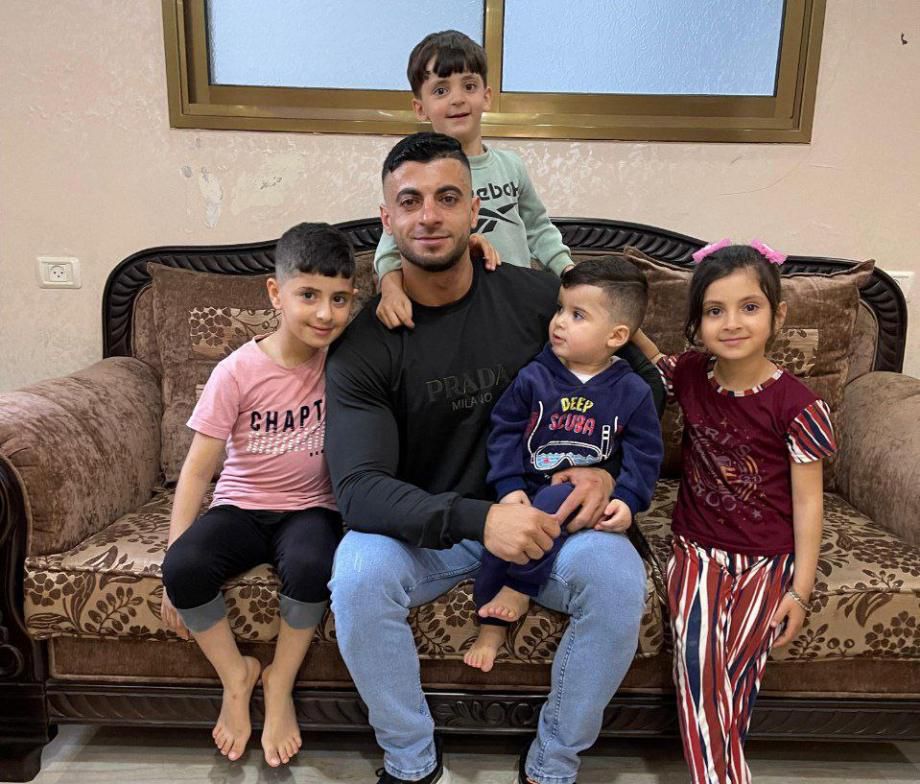
"The Story of the Odeh Family"
“A displacement journey turned into a funeral procession”
Under relentless bombardment from every direction, amid the weight of a merciless war, Hussein Odeh held his children close for a brief moment — wrapping them in his arms, trying to quiet their fears, wipe their tears, and comfort them. In that patch of death, his voice carried a fragile note of hope:
“I’ll go get the car. The driver is waiting for me at the end of the road. Wait for me.”
His three children were dressed and ready, standing beside him at the entrance of their home in Jabalia Camp, northern Gaza, preparing their belongings for yet another displacement. A tent awaited them in the Tel Al-Hawa neighborhood, southwest of Gaza City.
The father took a few steps forward to bring the driver, while his children ran inside, calling out to their mother, who was preparing a quick meal:
“Mama, hurry — the driver’s here!”
Their cry carried both the taste of survival and death.
The house never left Hussein’s sight, even as he walked dozens of meters away. He turned his head back just as he heard the whistle of a missile descending — followed by a massive explosion and a thick cloud of smoke that covered the area, rising from the direction of his home.
He ran back, plunging into the smoke, shouting for his children. Then the scene became clear. He fell to his knees — the last of his strength leaving him — after the house was bombed, burying his wife and children beneath it.
He called their names, again and again, through moments of silence mixed with rubble and dust. Then, from somewhere nearby, a faint voice cracked through the chaos:
“I can hear you.”
That small sound rekindled a flicker of life in his heart. Neighbors and young men rushed to help, digging with their hands. From beneath the ruins, his children’s voices began to fade — and slowly drifted away, whispering their final peace.
After an hour of digging, they finally pulled out the source of the voice — his wife, who was found alive but with fractures in her spine and pelvis.
Beside her, they recovered the body of their three-year-old son, Mohammed, who had been racing with his brothers — cooking on the balcony — to tell her that the driver had arrived. It was as if he had reached the finish line of a life that had barely begun.
But the young men and rescue teams couldn’t reach the bodies of his two other children, Khaled (10 years old) and Youssef (7 years old).
Hussein buried his brother, who had been on the upper floor, along with his little Mohammed — yet he couldn’t retrieve the bodies of his two sons, as Gaza lacked the necessary equipment to dig them out from under the rubble.
A Father Shattered
Hussein Odeh — Gaza’s bodybuilding champion — now sits alone inside a makeshift tent, a silent witness to his shattered fatherhood.
His once powerful body, built for strength and competition, can no longer bear the weight of his children’s absence.
He speaks softly of his pain — a pain that no muscle could ever endure.
“What hurt me the most,” says Hussein Odeh, “is that my children were already dressed, and we had packed our belongings after a sleepless night filled with bombing, fire belts dropped by Israeli warplanes, and evacuation orders. But instead of escaping, our journey turned into a funeral.”
With a heart heavy with sorrow, his face soaked in grief and eyes hollow from loss, he recalls what happened:
“I don’t know why our home was bombed. I tried to evacuate when I had a chance — not under fire. The situation didn’t seem that dangerous; many families were still there. My wife told me her family had prepared a tent for us, and she was afraid for the few children we had left. So I arranged with a driver to come at noon, and we had everything ready. Half an hour before he arrived, I stood at the door with my children. When the driver called to say he had reached the entrance of our street, I walked ahead to get him — not knowing that my children had gone back inside to tell their mother he’d arrived.”
Standing before the horrific scene, his voice grew heavier than the weights he once lifted:
“When I came back, the four-story house was in ruins. With the help of neighbors, I could only recover my little boy, Mohammed, and pull my wife out alive. I don’t know if I’ll ever be able to retrieve the bodies of my sons Khaled and Youssef — just to look at them one last time. I want to bury them beside their sister Iman and Mohammed.”
He continues, his voice trembling:
“When I reached the destroyed house, I stood there — lost, unable to tell where my family had been. Then I heard a faint sound from beneath the rubble — it was my wife. She had been trapped under debris and darkness for an entire hour. I begged the young men from the camp to help dig her out. What saved her was that she had been standing on the edge of the house, cooking over firewood.”
The sound comes from a heart crushed by pain.
But losing his three sons on May 17, 2025, was not Hussein’s first tragedy. During the October 7, 2023 war, just thirteen days after Israel began its assault on Gaza, his home’s ground floor was bombed, killing his six-year-old daughter Iman, his mother, his two sisters, and his brother Omar, who had Down syndrome.
He recalls the first bombing:
“They hit the ground floor while I was upstairs with my children. My daughter was visiting her grandmother — and was martyred with her. Since the start of the war, I have lived in deep pain. Losing my daughter, my mother, and my siblings was unbearable. I lived afterward in schools and displacement camps. When the truce was announced last January, I returned to live among the rubble, thinking the war was over. But it came back — and took all my children.”
ناجي
"The Story of the Odeh Family"
Hussein Odeh
تل الهوا
Age: 35
November 28, 2025