"The Story of the UNRWA Clinic"
“The Missiles Struck Them Just Hours Before a Holiday Celebration”
The UNRWA Clinic Massacre: An Infant Beheaded, Children Consumed by Fire
What was her sin? What did this little one ever do to them?!”
A mother’s heart burns with the fire of loss, moments after watching an Israeli missile set her children ablaze inside the UNRWA clinic in Jabalia Refugee Camp, northern Gaza.
There was no forehead left to kiss—
the missile had torn off her infant daughter’s head, sparing nothing of her tiny body.
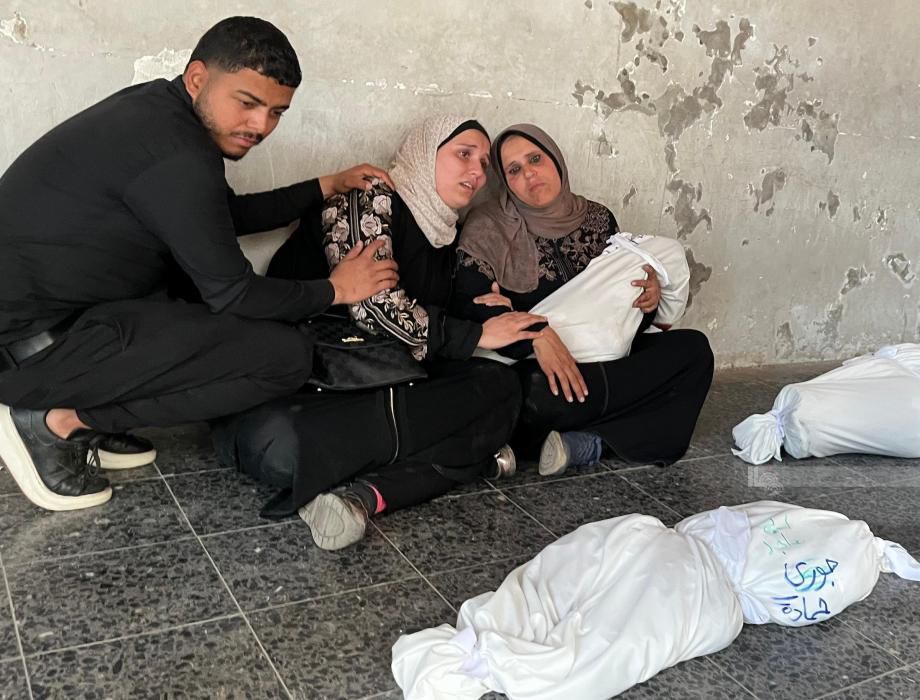
Inside the courtyard of the Indonesian Hospital’s morgue, the bodies of about 22 martyrs lay side by side — 16 of them children, along with women, the elderly, and dozens of the wounded. The doctors could hardly recognize their faces; the features were gone. On one small shirt they wrote, “red blouse,” the only mark left to help families identify their loved ones. Similar notes were placed on other bodies, waiting for the mothers and the few survivors to arrive.
The mother of the infant Amal Youssef Alayan, now gone with her siblings, stood torn by grief — unsure where to begin her mourning, which body to cry over first. Her screams cracked through the air, a mix of agony and guilt for not being there at that fatal moment:
“My dear Anous, I wish you’d stayed with me… I wish my baby girl had remained in my arms.”
She stood before the shrouded bodies of her children, touching their altered faces, tracing their small hands through the white cloth. Despair carved itself into her features, and sorrow clung to her trembling voice:
“I saw the rubble covering me, I tried to lift it and stand up — then I saw the fire consuming my children’s bodies. They were all gone… my baby, born just two weeks ago — I couldn’t even find her head.”
Beside her, another woman clutched one of the bodies in silent sobs, her grief too deep for sound — her embrace long and wordless, her tears the only language of loss. Nearby, a little girl choked through her tears, whispering to her father’s lifeless body:
“Why didn’t you want to sleep at my place, Baba?”
Blood spreads across the shrouds of the murdered children, as the eyes of their mothers overflow with grief, rage, and unbearable pain. The scene captures the utter horror of genocide.
Moments earlier, a young man was seen carrying what was left of the infant’s body — lifting her headless remains with one hand, his arm drenched in her blood. With trembling rage, he shouted words meant to shatter the world’s silence:
“What was her sin? What did this baby ever do?”
After a deafening explosion struck the UNRWA clinic, massive flames erupted, devouring everything in their path. Displaced men and youths rushed to fight the fire, using buckets hastily filled from any available water source inside the clinic, which had no proper supply. Each person brought what they could — drinking water, wash buckets, anything — trying desperately to put out the blaze, to stop it from reaching more bodies.
The massacre erased entire families from existence.
The Abu Sa’da family was wiped from the civil registry:
Ahmed Abu Sa’da, his wife Iman, and their children Bayan, Obaida, Bisan, and Ubada — all killed.
From the Alayan family, Youssef Alayan, his wife Amani, and their children Abdullah, Anas, and the infant Amal were all martyred as well.
Only ashes and blood remained — whole families gone, their names turned into whispers beneath the rubble.
A bite dipped in blood before noon.
The UNRWA clinic—turned into a shelter—was alive just hours earlier. Before the bombing, the Alayan family had just finished preparing breakfast after struggling to cook over an open flame.
Hussein Abu Al-Eish, who lived through those final moments, recalled to Palestine Online:
“It was before twelve noon. We were preparing breakfast and living a normal life. The Alayan family finished eating before me, shared some of their food with us, then went back into their shelter room. I stayed behind tending the fire.”
Then the bloody details returned to him in flashes:
“A sudden airstrike hit, and the flames spread to nearby rooms—some only separated by sheets, since the walls had already been destroyed in previous bombings. I dropped everything and ran inside. I checked on my wife and my only son, who was asleep, and got them out. I entered the Al-Sa’da family’s room—there was nothing left of them. They were wiped from existence.”
As fire devoured room after room, a woman’s scream broke through the chaos:
“My daughter Amal, she’s only two weeks old—save her!”
Abu Al-Eish grabbed whatever water he could find—buckets meant for drinking—and threw it on the flames. Neighbors joined in, bringing every drop of water from their tents and rooms. They managed to pull out the headless infant and other children burned alive.
“Each scene was worse than the one before,” he said. “A baby without a head. A woman burning alive, rolling in flames. Children charred. It felt like scenes from the Day of Judgment.”
He inhaled deeply, trying to recall the life that had existed before the massacre:
“We used to try to make the children happy—organizing small parties, blowing balloons, giving them toys for Eid. That day, we were planning another celebration... but instead, we held a funeral.”
On the second floor of the clinic, the walls were blackened, the children’s toys burned, their clothes charred, and their blood and body parts scattered across the rooms—silent witnesses to the massacre of childhood dreams.
Despite starvation and siege, there had been a fragile form of life.
“The children lived a partial joy,” Abu Al-Eish said wistfully.
Among the 150 families sheltering there, the cries of baby Amal were now silent.
“Her mother used to bring her to my room so she could rest in peace and warmth away from the noise. For two weeks she lived in calm. I never imagined she’d leave the world this way—without a head.”
He ended his account with a shattered sigh, one that seemed to come from the deepest part of his soul.
From another corner of the scene, Hossam Shalail told Palestine Online:
“The displaced people heard one explosion, but there were actually two simultaneous strikes from different directions, which caused this massacre. When we arrived, we found a wall that had fallen over some people—it protected them from the fire. We rescued them. Water was scarce, and the flames were huge, so we used blankets, buckets, anything to extinguish it.”
In shock, he struggled to describe what he saw:
“There was panic and chaos. Women and children crying. Fire everywhere. Torn and scattered body parts… The horror was beyond words.”
That Eid, families at the shelter had tried to bring joy to their children—simple celebrations over three days to lift their spirits and distract them from the war. But the missiles that struck spared no one, turning laughter into ash.
The targeted UNRWA clinic had once been a main health center, serving the camp’s residents. During the war, it became a shelter for displaced families, believed to be a safe place—until that illusion was shattered.
On April 2, 2025, it became the site of one of the war’s bloodiest massacres, another chapter in the story of a people who sought refuge—and found fire
شهداء
"The Story of the UNRWA Clinic"
UNRWA Clinic
مخيم جباليا
December 01, 2025