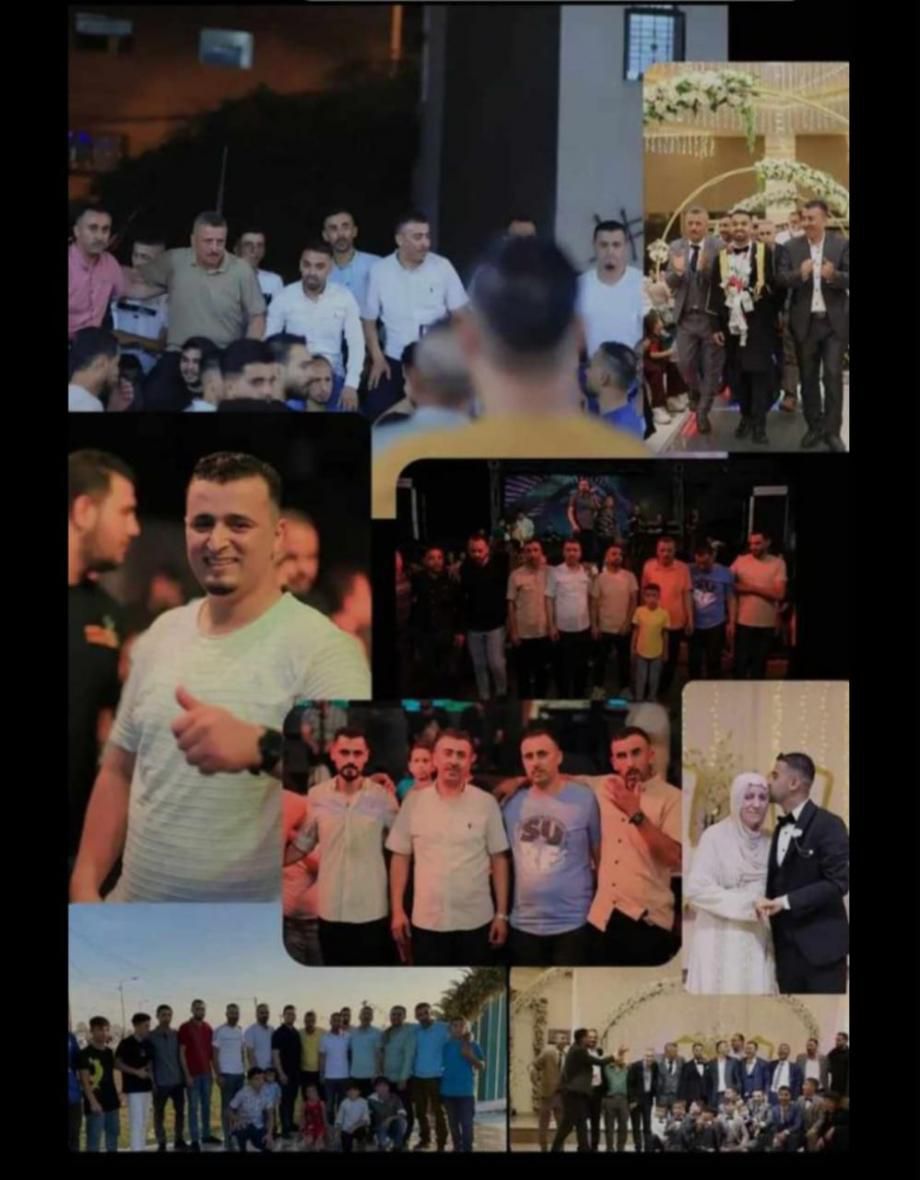
The Story of the Al-Madi Family"
The newlyweds wore burial shrouds instead of wedding suits
The Story of the Al-Madi Family: 25 Martyrs and Joy Turned into Mourning!
The names of the wedding guests were printed on invitation cards for the ceremony scheduled on October 19, 2023. The bride, Rahaf Suhail Madi, had prepared herself to leave her family home. Everything was arranged — her wedding dress, the henna night planned for the 12th of the same month, and her luggage, ready to be moved to her new home with the groom.
This long-awaited celebration was not the only one in the family. Two of Rahaf’s cousins, brothers Ahmed and Mohammed Abdel Rahman Madi, were also preparing for their weddings on November 7, with their apartments furnished, invitations printed, and the wedding hall booked. The family was joyfully anticipating three consecutive weddings, where songs and ululations would fill the air, marking the first weddings among the young men of the Madi family.
However, with the outbreak of the genocidal war on October 7, everything changed. As the artillery shelling and fire belts intensified across Gaza City — especially in the Zaytoun neighborhood, where the family lived — the Madi family, consisting of the grandmother, five brothers with their wives and children, and a married sister who joined them, were forced to flee to Deir al-Balah in central Gaza.
More than 25 people lived together in a two-story house, along with other displaced families. They shared everything — food, shelter, and sorrow — united by bonds of affection and kinship that remained their only solace after their homes, memories, and dreams were destroyed. Their three upcoming weddings had been replaced by a cruel reality of survival.
October 19 arrived, but Rahaf and her fiancé Sobhi, who had fled with her family, never celebrated. Their small apartment remained silent, waiting for the joy that never came. Meanwhile, Israeli tanks advanced toward their home in Zaytoun, reaching the carefully packed wedding bags Rahaf had chosen with her mother. The tanks crushed the family’s memories, tore through the house’s pillars, and buried Rahaf’s bridal belongings beneath the rubble.
On the afternoon of December 5, 2023, grandmother Amira prepared what would be the family’s last lunch. Her sons — Abdel Rahman, Ahmed, and Mohammed — gathered around the meal with their children and sister Halima, who had also fled with them. Upstairs, Suhail’s wife, Rahaf’s mother, was sitting with women from other displaced families renting the upper floor. She left the gathering to prepare lunch for her husband, who was fixing his car beside the house, standing with his only son Khalil and Rahaf’s fiancé Sobhi. Nearby, Rahaf and her sisters Reem, Hala, and Lama were helping their mother, while her youngest daughter Lana (9 years old) asked permission to go downstairs to play with her cousins.
Moments later, fate drew a devastating line between life and death. An Israeli missile weighing one ton struck the house, reducing the two-story building to rubble and covering the sky with smoke and dust.
“I flew through the air and found myself in the street with my daughters, who suffered multiple fractures,” recounted Sabrine Madi to Palestine Online, describing how her family’s joyous celebrations turned into funerals, as the grooms wore shrouds instead of wedding suits.
The Israeli occupation uprooted the Madi family tree from its roots, killing most of its members. Twenty-five people from the family were martyred, along with around twenty others from displaced families who had sought shelter in the same building. In total, about 45 people were killed in a single strike.
Only a few survived — Suhail Madi, his wife Sabrine, and their daughters Rahaf and Lama, who suffered fractures in their pelvis and face. Their other daughters, Reem and Hala, also survived, while their youngest, Lana, was killed. Their son Khalil survived with a broken leg, and Rahaf’s fiancé was severely injured in the head and abdomen. Four of Suhail’s nephews also survived and are now under his care, having lost their parents and siblings. These children emerged from the rubble to continue life without a family, without parents — their small bodies marked by fractures and wounds.
Mahmoud Abdel Rahman Madi, nine years old, survived but lost seven members of his immediate family. He carries the name of his father, who had been preparing for the weddings of his sons Ahmed and Mohammed, both of whom were killed with him — their joy turned into mourning, and the Israeli bombardment ended their long-awaited celebrations before they began.
Abdel Rahman Mohammed Madi (18) was left paralyzed after a spinal injury, now confined to a wheelchair and alone after losing eight family members. He requires long-term medical and psychological care. His brother Khalil (2½ years old) survived, but too young to grasp what happened — he still believes his parents and sisters Taleen, Tala, and Sham, who were killed in the massacre, will return to him someday.
Among the martyrs were Amir Madi and his wife, newlyweds who had celebrated their marriage only three months earlier. The family had shared joyful days at their wedding and was eagerly awaiting three more weddings in October and November — none of which would ever take place due to the devastating war.
The grandmother, Amira, the elderly matriarch who gathered her children under her wings of warmth and love after their father’s death, was also killed. Instead of wearing her traditional Palestinian dress shining with joy at her grandchildren’s weddings — Mohammed, Ahmed, and Rahaf — she wore the white shroud, just like her martyred grandchildren. Her daughter Halima and her children were also killed, despite seeking refuge in Deir al-Balah, which the occupation had falsely declared a “safe zone.”
After the massacre, neighbors and relatives helped clear the rubble for hours. Suhail Madi, the only surviving brother, managed to recover the bodies of his mother Amira, his brothers Abdel Rahman, Mohammed, Ahmed, Amir, his sister Halima, his daughter Lana, and his nephews and nieces. He stood before 25 bodies, leading their funeral prayer — a heartbreaking moment for a man who had shared a joyful and united life with his brothers before the war, endured hardship with them during it, and now found himself alone, continuing the journey of displacement without them. He was left with only a few children — the remnants of an entire family — to raise.
Suhail lost his daughter Lana, and his family was torn apart. His wife Sabrine traveled to the United Arab Emirates to treat their daughter Lama, while his daughter Rahaf, the bride who was to be married on October 19, is now recovering from her injuries in Egypt. “Since the massacre,” says Sabrine, “we have not been together in one place.”
She adds, her voice heavy with grief:
“There are no words to describe the pain of loss that struck our family. When the faces you used to see every morning are gone, you find yourself staring at old photos and memories on your phone, drinking the bitterness of grief over and over. You wish it were a nightmare you could wake from — but it’s a harsh reality, one where you must keep living with only a few survivors of your once-big family.”
She pauses, remembering the days before the tragedy:
“On October 7, we were preparing to distribute the henna invitations. Everything was ready — the names, the decorations, the hall booking. But all the weddings ended before they began. Those we were preparing to celebrate with are now martyrs.”
Describing their close family life, she says:
“We lived like any ordinary family — gathering during holidays, all under one roof. Because of how close they were, the brothers insisted on fleeing together to the same house in Deir al-Balah.”
Suhail, now the only surviving brother, works with the Civil Affairs Authority. His martyred brother Abdel Rahman was a farmer since childhood, Mohammed was a driver, Ahmed worked for Palestine Telecommunications Company, and the youngest, Amir, sold clothes.
Sabrine recalls the day of the massacre as if it were happening again:
“We were so happy that morning. Everyone gathered for lunch. Then, suddenly, without warning, an Israeli missile struck. I didn’t see anything — I just felt myself thrown into the air. When I woke up, most of my husband’s family was gone. We couldn’t even find any remains of my daughter Lana, our family’s little butterfly.”
Eid al-Adha now passes heavily on Sabrine’s heart and her daughters’. The holiday, once filled with laughter and shared traditions, has become a reminder of loss.
“We used to buy the sacrifice together, gather the children to watch, then dress them in new clothes. We’d visit each other and go to my mother-in-law’s house. Living in a rural area made us even closer as a family.”
In a small video filmed as she lay on a stretcher in an ambulance, Lama (12) waved goodbye to her relatives at the Rafah crossing. After three months of treatment abroad, she is beginning to walk again. Her mother explains:
“My little girl endured two wounds — first, losing her sister Lana (9), who was like her twin, and second, the pain of her pelvic fracture. She went through multiple surgeries before she could finally walk again.”
Now, between the injured still recovering and the children trying to adapt to a life without their parents, the remnants of the Madi family live a life devoid of joy, warmth, and family presence. Their extended family has shrunk, their home emptied of laughter, and their loved ones reduced to faces in photo frames.
The uncles, cousins, and grandmother are gone. And for Rahaf, the bride who once dreamed of her wedding day —
what celebration remains after the war, when everyone she loved is gone
ناجي
"The Story of the Al-Madi Family"
suhil Madi
دير البلح
Age: 48
November 27, 2025