"The Story of the Al-Alyan Family
A tree that lost all its leaves in the autumn of loss.
Her gaze froze as she read a message on Telegram — news of a strike that had targeted the house where her family had sought refuge after fleeing from Al-Shati Camp in Gaza City to Al-Nuseirat Camp in the central Gaza Strip, at dawn on November 21, 2023.
For a few seconds, her mind went blank as she watched a video showing the recovery of 48 bodies, among them her parents, brothers, sisters, their children, and the sister and children of the homeowner.
Sabrin Alayan watched the leaves of her family tree fall one by one — the branches stripped bare, the roots torn from the ground. The autumn of loss had descended upon the hearts of the survivors. Time stopped for her, or perhaps she was trapped in a nightmare she couldn’t wake from.
Hours passed as her mind flooded with questions, her heart overwhelmed with unbearable pain. Tears streamed down her face as she looked, in disbelief, at the names of her loved ones written on brown body bags, containing fragments of the family she once knew. She burned with a grief she had never known — never imagining she would live to witness the collective disappearance of her entire family.
Just two days before the humanitarian truce, a massacre was committed against the Alayan family. For four days, rescue teams continued to recover bodies from beneath the rubble of the three-story house — leveled to the ground by Israeli warplanes. The home belonged to Dr. Abdul Latif Al-Hajj.
A “Safe” Home
When the residents of Gaza City and northern Gaza were forced to flee amid the ongoing genocidal war, the Alayan family — originally from Al-Shati Camp — decided to evacuate like many others. Their destination was the home of Sabrin’s sister Aya, an employee with the UN Development Programme (UNDP), and her husband Dr. Abdul Latif, who had opened their doors to host dozens of displaced relatives, believing their home was safe and away from the reach of Israeli airstrikes.
“My father, Abdul Aziz Alayan; my brothers, Mohammad, Mahmoud, and Yousef; and their families; and my sisters, Nisreen and Jihan, with their children — all went to Aya’s house two weeks after the war began, thinking it was safe,” recounts Sabrin Alayan, their sister living abroad, her voice breaking with tears as she tells the story of a family uprooted and annihilated, losing 37 members from their close circle alone.
Her sobs interrupt her words before she gathers her strength to continue:
“We kept hoping to find survivors, but when I saw the building flattened, all hope faded. I zoomed in on photos and saw the names written on the body bags — my father, my mother, my brothers. Those moments were beyond comprehension.”
From the top of the family tree, her father Abdul Aziz (86) and mother Zainab Al-Ghoul were killed. Her brother Mahmoud, a coordinator at the Civil Affairs Office, was martyred with his wife and four children — the youngest only three months old. Her brother Mohammad was killed with his four children, aged between 6 and 14, while his wife Noor Adnan Al-Ghoul survived but lost her entire family. Noor’s mother — the widow of martyr Adnan Al-Ghoul — also died in the bombing.
Her brother Yousef, a nurse at the Eye Hospital, was martyred, though his wife and children survived because they were staying elsewhere that night. Her sister Nisreen was killed with her sons — pharmacist Issam, his two children, and engineer Hossam Abdel Rabbo, who worked for Ooredoo Telecom, and his son. Nisreen’s daughters — Isra’a, Afnan, Misk, and Raghad — were all martyred too, most of them recent university graduates.
Her sister Jihan was martyred with her husband Khaled Al-Hamlaoui, their son Mousa, and daughter Lina, along with Lina’s husband and two young children, Yahya and Lynn.
From the Al-Hajj family, Sarah, Qassam, and Deema Al-Hajj were also killed — Deema along with her husband and infant child; she had worked for the World Health Organization (WHO).
The only survivors were Dr. Abdul Latif Al-Hajj, who was at work at the hospital during the strike, and his wife Aya, who suffered fractures in her chest. Their daughter was injured, while their two grandchildren survived: Abdul Rahman (7), with pelvic fractures, and Aya (14 days old), who was born during the war and miraculously pulled alive from under the rubble, despite brain bleeding. Two other children from the extended family also survived.
An Empty Land
The Alayan family owned a large plot of farmland in northern Gaza, inherited from their mother. It was a gathering place on weekends and holidays.
“Our family was close-knit and well-known — peaceful people with respected jobs, devoted to education and sports. Some of my nephews studied music at the Edward Said National Conservatory, others played basketball,” Sabrin recalls.
She remembers their unity fondly:
“We were always together. Cousins felt like siblings. There was so much love.”
Her voice trembles with grief as she continues:
“We always met for joyful occasions — Thursday and Friday nights on the farm, family iftars during Ramadan, and large gatherings during Eid. There was so much life and laughter.”
Now, only six sisters remain — three abroad and three in Gaza: Aya, who lost her children and home; Ummiya; and Suhair, who undertook the painful task of identifying all the bodies, recognizing her loved ones among the torn remains.
“We face a long journey of pain,” Sabrin says quietly. “It still feels like a dream we can’t wake up from.”
The Alayan family is gone, but their farmland stands as a silent witness to the memories they once built there — a place that now echoes with the absence of laughter. Their home in Al-Shati Camp lies abandoned, its doors forever closed.
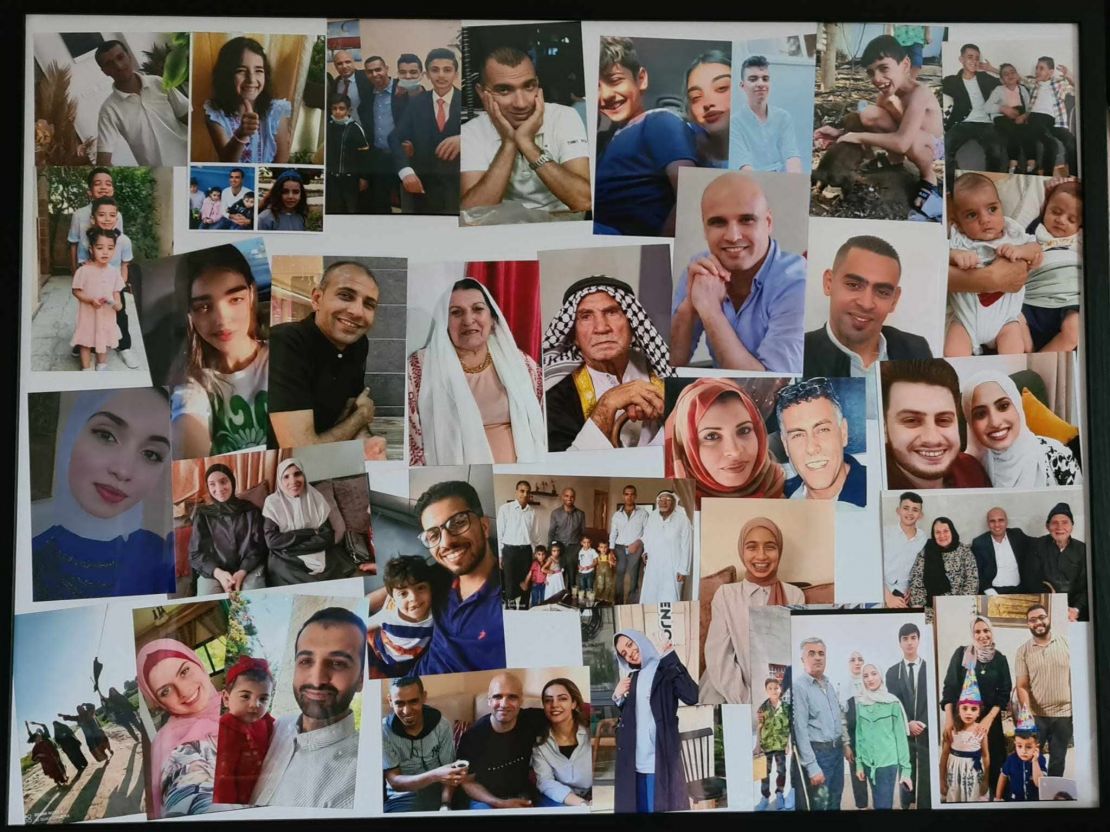
Faces and names that once filled generations now exist only in a single framed photograph — a family tree reduced to a grave, marked by a single stone bearing witness to one of the countless crimes of genocide committed by the Israeli occupation in Gaza.
ناجية
"The Story of the Al-Alyan Family
Sabrin Alayan
مخيم النصيرات
Age: 33
November 27, 2025